Radio AGN • Molecular Gas • Galaxy Transitions
When Do Radio Jets Begin to Affect a Gas-Rich Galaxy?
Radio jets are often associated with massive, quiescent galaxies, yet some low-excitation radio galaxies retain blue colors, substantial gas reservoirs, and signs of recent activity. These unusual systems may reveal what happens before jet-driven feedback becomes globally effective.
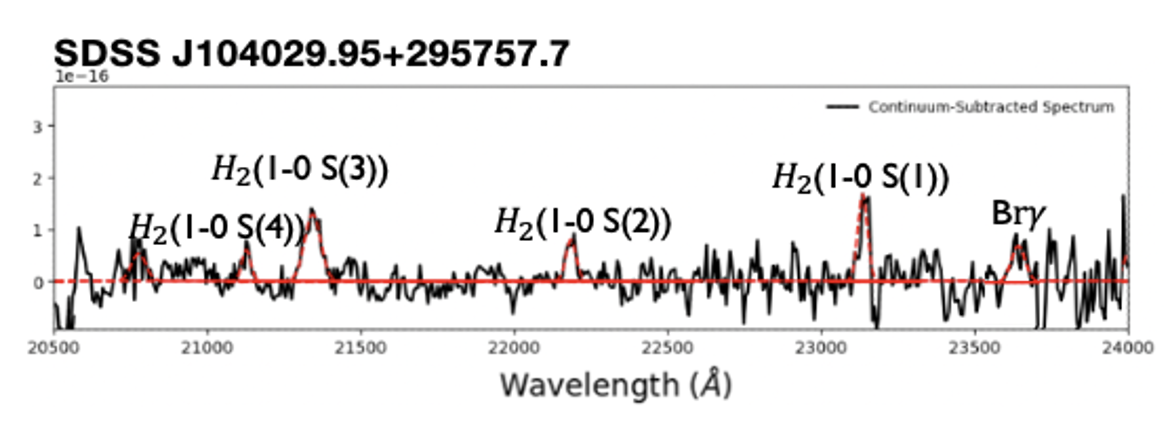
Using Gemini/GNIRS spectroscopy, radio imaging, and host-galaxy morphology, I find warm molecular hydrogen in several systems, with the strongest emission preferentially appearing in disturbed galaxies. The radio sources are generally compact, and the H2 emission does not show a clear positive trend with radio power. Together, these results suggest that merger-driven gas inflows and shocks can coexist with young or recently restarted jets before the jets fully couple to the galaxy-wide interstellar medium.
Why it matters: These galaxies may capture an early stage of mechanical feedback, when black hole fueling, disturbed molecular gas, and compact radio activity overlap rather than forming a simple sequence from star formation to quenching.
Explore this project