Radio AGN • Warm Molecular Gas • Galaxy Transitions
When Do Radio Jets Begin to Affect a Gas-Rich Galaxy?
Blue low-excitation radio galaxies may capture a short-lived stage in which disturbed gas, recent star formation, and compact radio activity coexist before jet feedback becomes globally effective.
A challenge to the classical jet-mode picture
Low-excitation radio galaxies are usually associated with massive, red, gas-poor systems in which radio jets help prevent cooling and maintain quiescence. Blue low-excitation radio galaxies are unusual because they combine radio activity with blue colors, disturbed morphologies, and in some cases evidence for young stellar populations or gas-rich environments.
Rather than assuming that these systems already represent positive or negative feedback, I use them to ask a more fundamental timing question: what does a radio galaxy look like before a compact jet has fully coupled to the surrounding interstellar medium?
Tracing warm molecular gas with Gemini
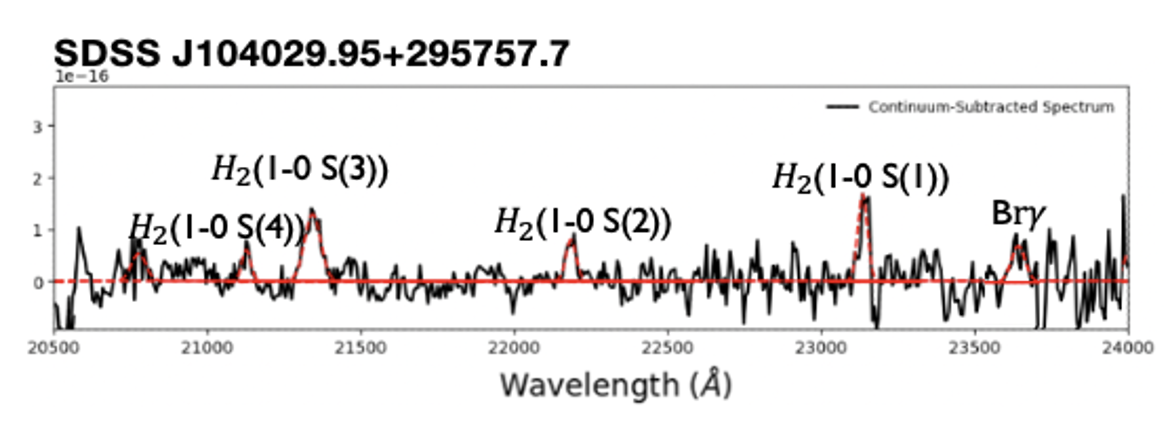
I obtained 0.8–2.5 µm Gemini/GNIRS spectroscopy of a nearby sample of blue low-excitation radio galaxies. The spectra target ro-vibrational H2 emission, recombination lines, and near-infrared forbidden lines that trace warm molecular gas, ionized gas, and possible shocks.
Warm H2 is detected in several systems, with excitation temperatures of a few thousand kelvin. The H2 luminosities overlap those of radio-emitting early-type galaxies, but they do not show a clear positive relationship with radio power.
Mergers, compact jets, and incomplete coupling
The strongest warm-H2 emission preferentially appears in morphologically disturbed systems, pointing toward merger-driven gas inflows and shocks as an important energy source. At the same time, the radio sources are generally compact, often extending less than roughly 20 kpc. Their small sizes are consistent with young, recently restarted, or environmentally confined radio activity.
Together, these results favor a transitional interpretation: merger-driven disturbances can heat and redistribute molecular gas while a compact jet is present, without requiring the jet to dominate the galaxy-wide gas energetics.
Why this matters for black hole–galaxy coevolution
These galaxies may reveal the overlap between black hole fueling and feedback rather than a clean sequence in which one ends before the other begins. They offer a nearby laboratory for studying how merger-driven gas inflows, star formation, shocks, and nascent mechanical feedback coexist during a brief phase of radio galaxy evolution.