Obscured Quasars • JWST/NIRSpec • AGN Feedback
Where Does a Quasar Outflow Transfer Its Energy?
Spatially resolved [Fe II] emission distinguishes gas carried by a powerful quasar wind from gas shocked where that wind encounters the host galaxy.
Detecting an outflow is not the same as detecting feedback
Quasar winds can extend across entire galaxies, but their presence alone does not reveal where their energy is actually deposited. To identify feedback in action, we need spatially resolved evidence that the outflow is heating, accelerating, or shocking the surrounding interstellar medium.
Obscured and reddened quasars are especially valuable for this test because they often host powerful outflows while remaining embedded in gas- and dust-rich environments where coupling may be occurring.
Separating gas in the wind from gas struck by the wind
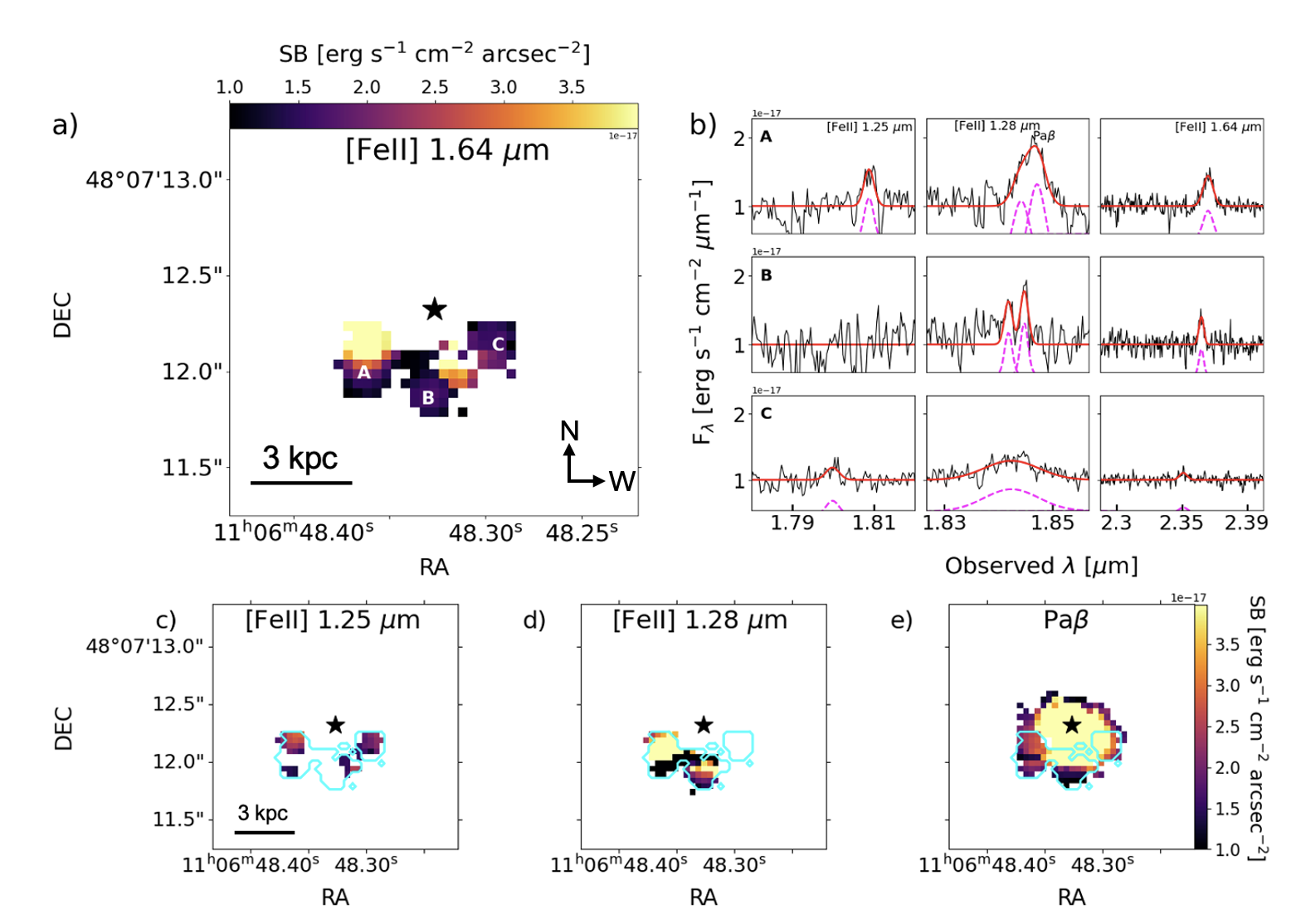
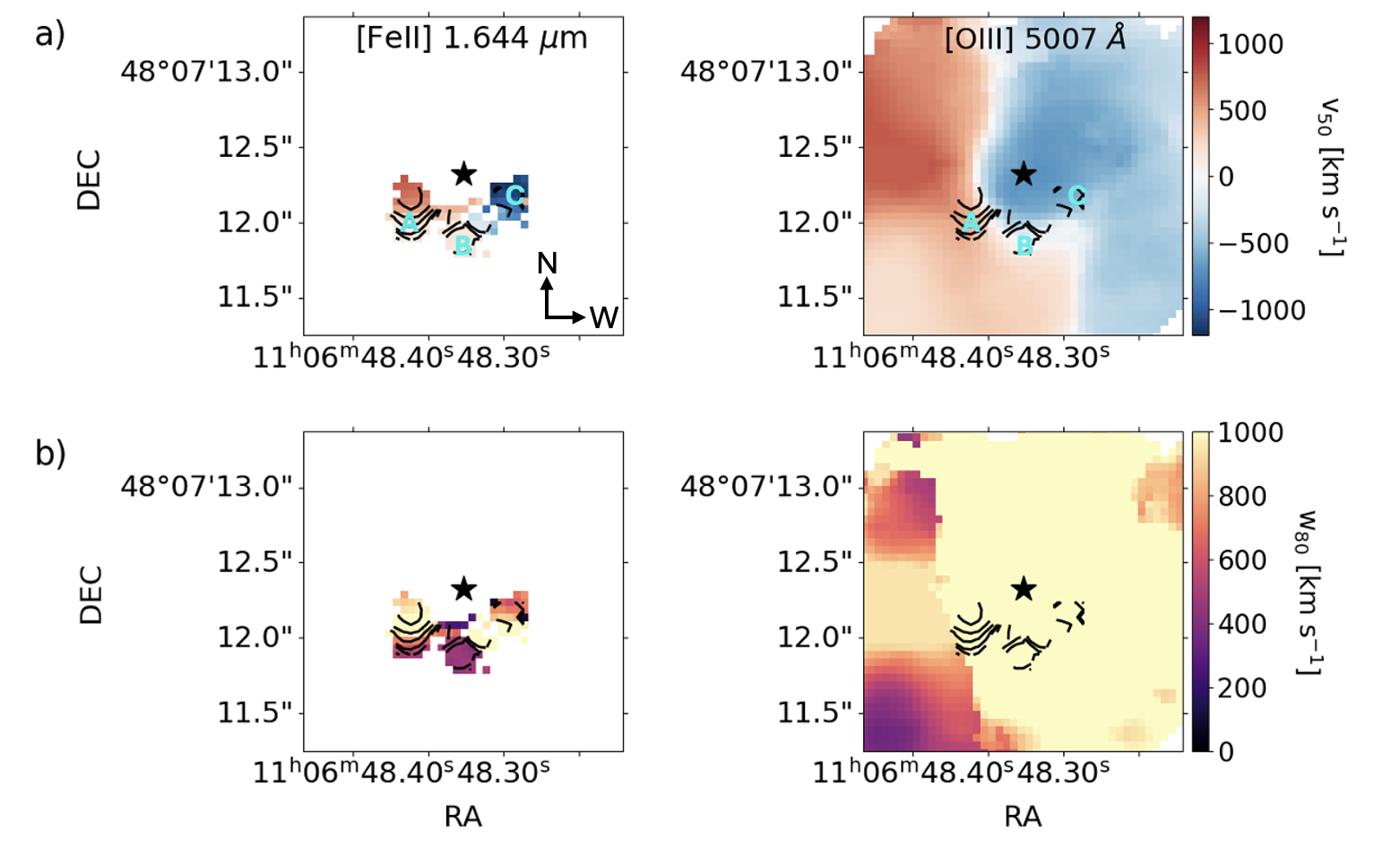
In the southeast and southwest, [Fe II] reaches median velocities of up to roughly 1200 km s−1 and line widths above 1000 km s−1. These kinematics closely track the ionized [O III] outflow, indicating that this [Fe II]-emitting material is part of the quasar-driven wind.
A separate southern component is much narrower, with a characteristic W80 of about 500 km s−1. Its kinematics are inconsistent with the extreme outflow at the same position, suggesting that it remains associated with the host galaxy.
The excitation mechanism reveals the impact site
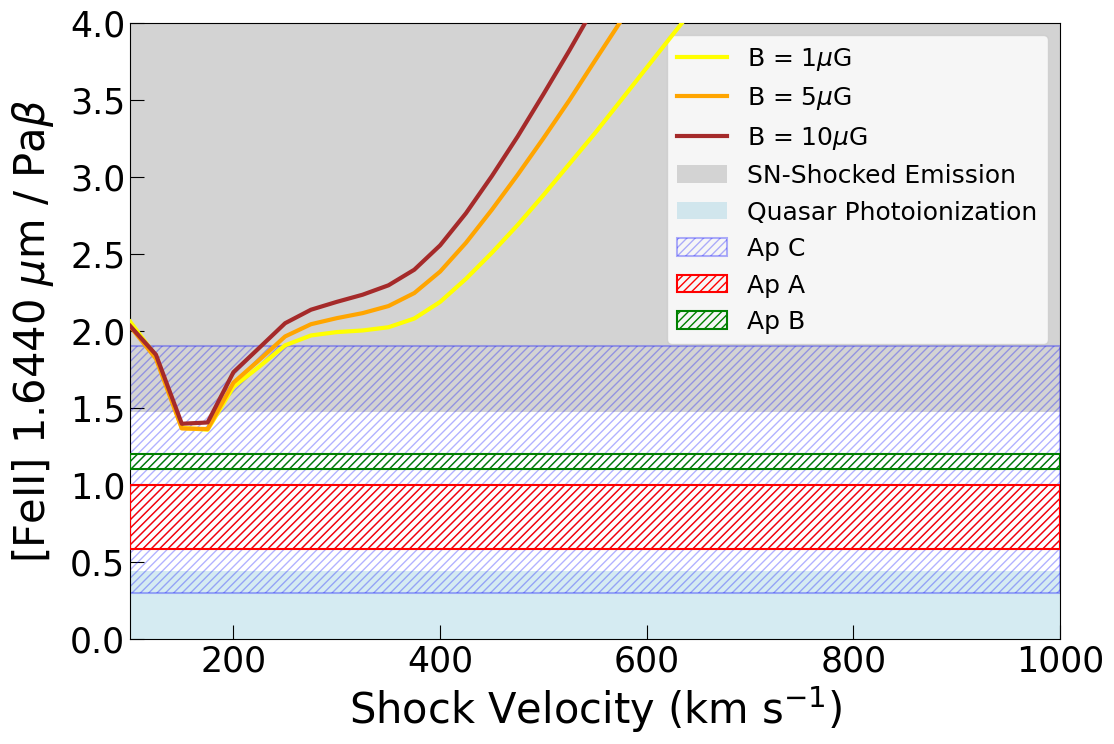
Emission-line diagnostics show that the high-velocity [Fe II] regions are largely consistent with AGN photoionization. By contrast, the southern component requires shock excitation.
The simplest interpretation is that the quasar wind is colliding with denser gas in the host galaxy, creating a localized shock outside the most rapidly outflowing material. This spatial separation makes it possible to distinguish the wind itself from the region where it begins to transfer energy.
Why this matters
This project moves beyond measuring the speed or extent of an AGN outflow. It identifies the interface between a quasar wind and the surrounding galaxy, providing a direct observational link between black hole activity and its local physical impact on the interstellar medium.