Cold Gas and Star Formation in Interacting Dwarf Galaxies: Sankar et al. 2025 in prep.
This study investigates how interactions between dwarf galaxy pairs influence molecular gas content and star formation—key processes in low-mass, metal-poor galaxies that dominate the early universe and the low-mass end of galaxy populations today. As part of the TiNy Titans (TNT) project, I use ALMA to observe CO(1–0) emission in 10 isolated dwarf galaxy pairs, detecting molecular gas in 7 of 19 galaxies (example shown below).

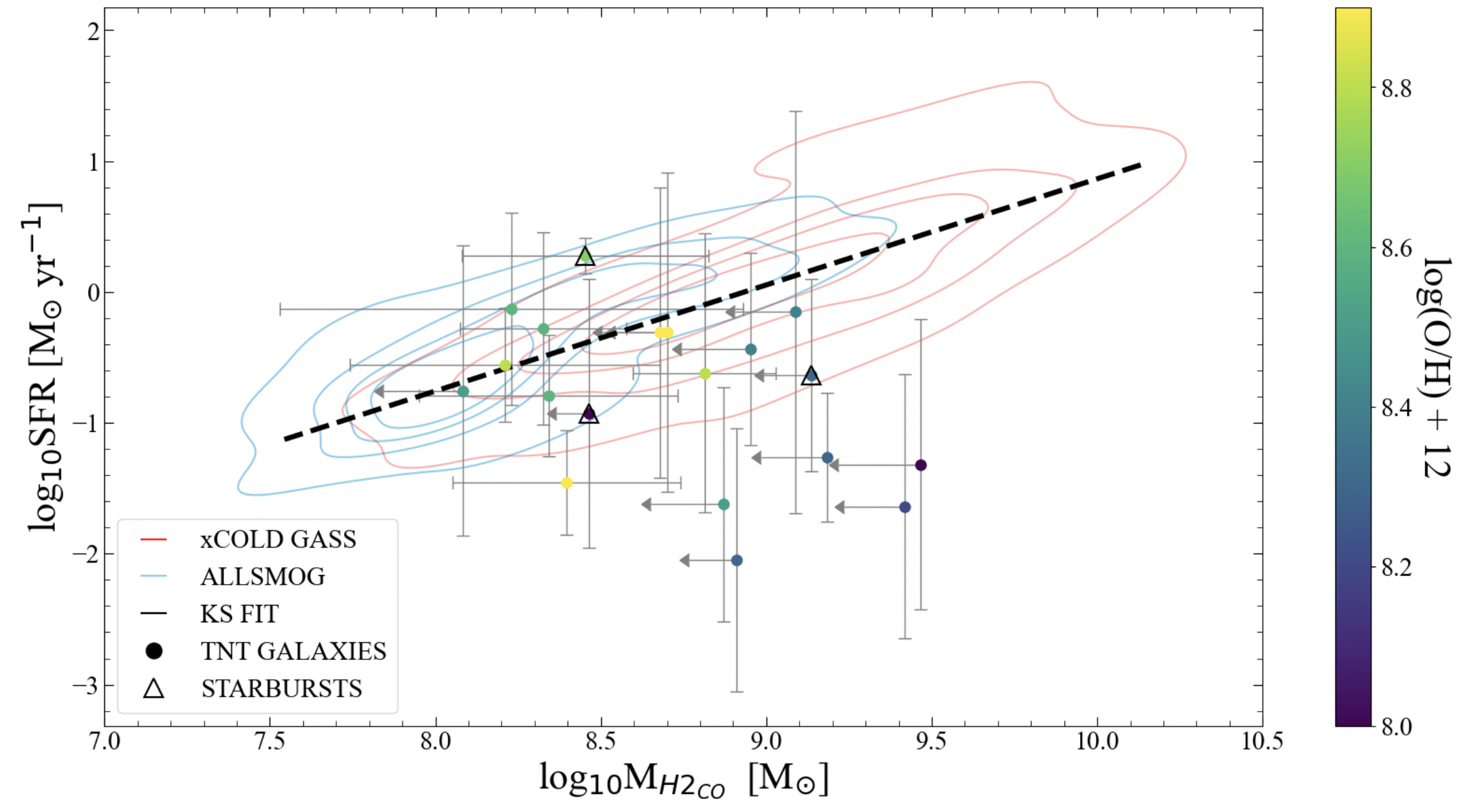
The typical H₂ masses (~10⁸ M☉) and star formation rates suggest no significant enhancement in star formation efficiency compared to isolated dwarfs (below). These results indicate that, unlike in massive galaxy mergers, interactions between dwarf galaxies do not necessarily lead to elevated star formation, at least in early stages. However, the modest detection rate and small sample size highlight the need for larger statistical samples to fully understand how gas dynamics and interactions shape star formation in low-mass galaxies. This work provides a critical first step in extending molecular gas studies to the dwarf galaxy regime.