 Swetha Sankar
Swetha Sankar
Swetha Sankar
Johns Hopkins University | Space Telescope Science Institute
Download CVPrevious research has established that supermassive black holes reside at the centers of massive galaxies and can reshape the gas from which galaxies grow. Through powerful winds and jets, active black holes inject energy and momentum into their surroundings, potentially suppressing, redistributing, or even triggering star formation. The central question of black hole–galaxy coevolution is therefore no longer simply whether black holes influence their hosts, but when that influence begins, how rapidly it develops, and under what conditions it changes the course of a galaxy.
The difficulty is that the most important phases of black hole growth and feedback are often the hardest to observe. They can be brief, heavily obscured by dust, or caught between different observational states. By the time we identify a mature active black hole (AGN), a large-scale outflow, or a powerful radio galaxy, we may already be seeing the outcome rather than the physical transition that produced it.
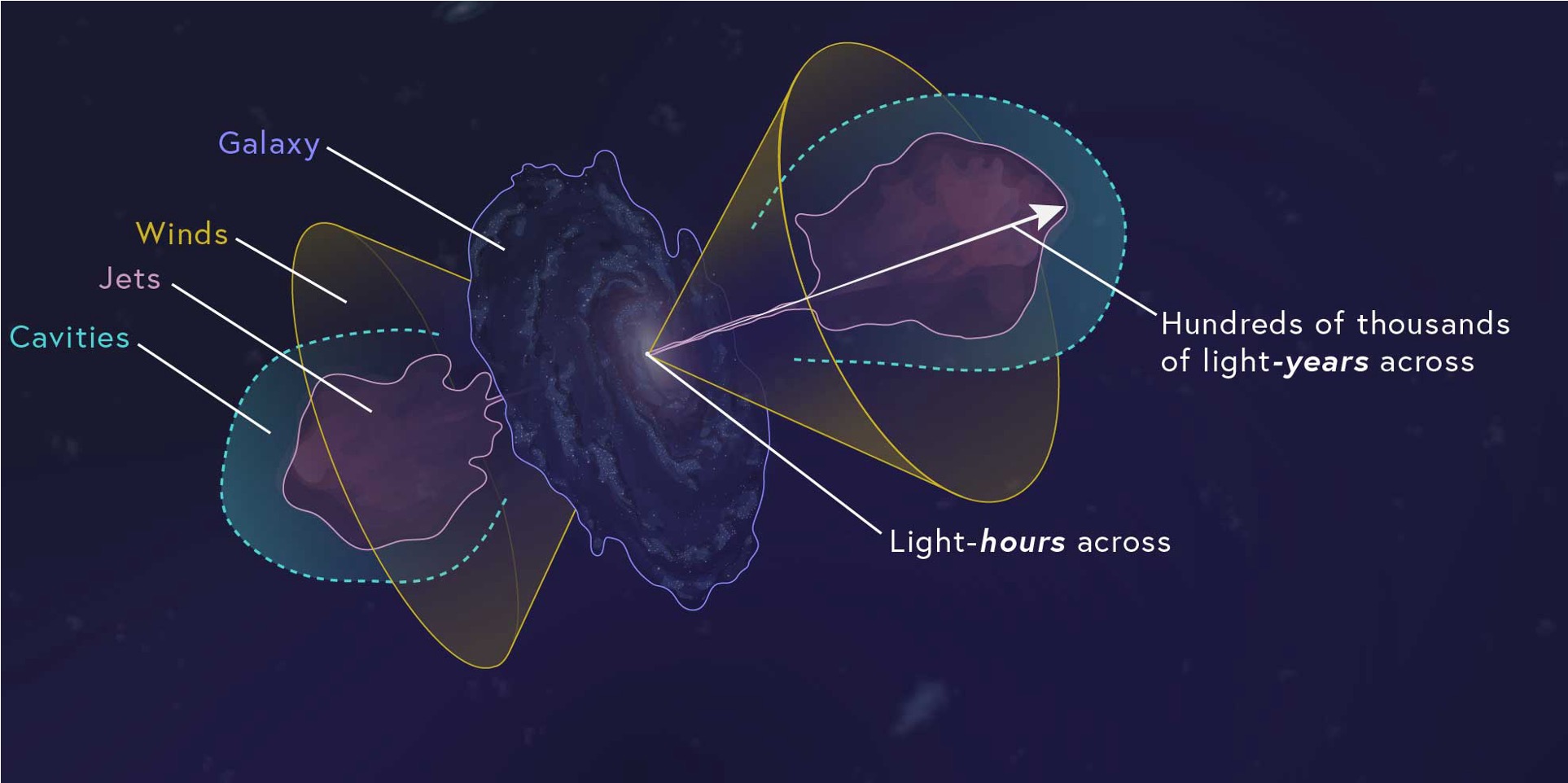
Credit: Leah Hustak / STScI
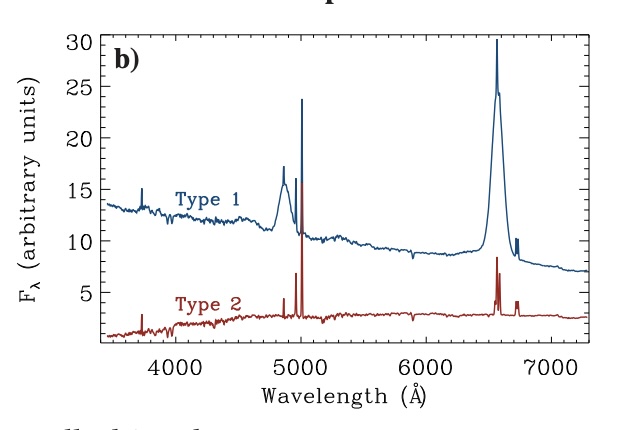
My research is motivated by a simple problem: we often study active galactic nuclei as static snapshots, even though the physics of black hole growth and feedback unfolds in time.
I study obscured and reddened quasars, changing-state AGN undergoing rapid Type 1–Type 2 spectral transitions, and gas-rich galaxies hosting compact radio jets. These systems offer rare opportunities to catch supermassive black holes while they are rapidly feeding, changing their accretion structure or obscuration, launching winds and jets, and beginning to transfer energy into the surrounding galaxy.
By combining multiwavelength longslit and integral field spectroscopy (with a focus on infrared), imaging, radio observations, and time-domain surveys from ground and space-based observatories, I trace the sequence connecting black hole fueling, obscuration, accretion-state changes, shocks, outflows, molecular gas, and the response of the host galaxy. Rather than treating feeding and feedback as separate processes, my work asks how they overlap, compete, and evolve during the short-lived phases when galaxies may be most susceptible to change.
The questions driving my work are:
STScI Director’s Discretionary Research Fund
Tracing the Evolution of Obscured Quasars at Cosmic Noon: A Study of AGN Feedback with Gemini/GNIRS
Maryland Space Grant Consortium Observatory Fellowship
STScI Director’s Discretionary Research Fund
Investigating Blue Low-Excitation Radio Galaxies: Unveiling AGN Feedback in Star-Forming Radio-Loud Systems
NSF Graduate Research Fellowship Program Honorable Mention
JWST Cycle 5 GO 10815
Following the Shocks: JWST IFU Spectroscopy of NGC 4258’s Radio Arcs
Roman Cycle 1 GO 10335
A Spatially Resolved Look at the Relationships between Star Formation and AGN
JWST Cycle 2 GO 3807
Deep Grism Spectroscopy of the Complex Environment around an Extremely Red Quasar within an Ultramassive Host at z = 3